Introduction #
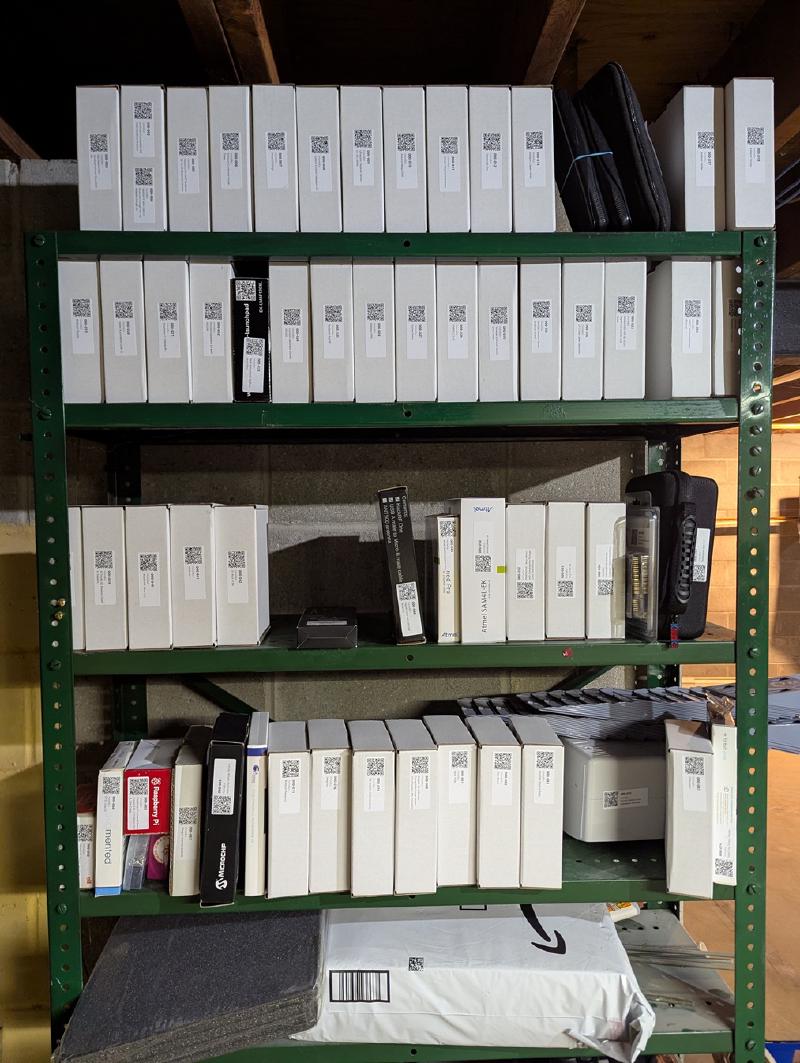
Like many engineers I have accumulated a large number of development kits and tools over the years. Some of these come with their own enclosures, some come with custom boxes, and some come as simple PCBAs that may not even have standoffs. I recently went through my current storage system (throw them all loosely in a Costco tote, the proverbial “junk bin”) and decided it was time to look at improving my storage to protect my tools from random mechanical or static damage and keep a better record of what I already have.
In the article below I loosely define the requirements for my ideal storage solution and walk through a few different options I evaluated.
Requirements #
The requirements I came up with for an ideal PCBA / embedded device storage system are:
- Mechanically protect the boards from collisions with other items in the storage area.
- Electrically protect the boards from static damage.
- Contain a flat surface for labeling individual items that is at least a 1" x 5/8" area (to fit Avery 5260 address labels).
- Affordability - The system should cost less than $5 per container fully assembled and ideally far lower.
- Physically constrain the items so they do not move and risk damage when they are picked up, knocked over, or shaken.
- Minimize the physical overhead required in each dimension
- One size fits most - the storage system should not require modifications or different parts for every different size of PCBA or embedded device.
- Last indefinitely - Anything with a shelf life less than 5 years will be a nuisance to maintain and replace.
To add detail to requirement #7 I measured a selection of 8 different parts to come up with a worst case envelope.
| Item Description | Length (mm) | Width (mm) | Height (mm) |
|---|---|---|---|
| Microchip SAMV71 Xplained | 135.2 | 96.7 | 18 |
| Arduino USB Host Shield | 69.1 | 53.7 | 19.7 |
| DE0 Nano | 77.1 | 48.5 | 22.7 |
| Homemade Raspberry Pi Breakout Board | 50 | 50 | 23 |
| XR2206 Function Generator | 71.2 | 55 | 36.2 |
| Stellaris Launchpad | 66.4 | 51.2 | 18.6 |
| Arduino Mega 2560 | 108.5 | 53.5 | 14.2 |
| Raspberry Pi 3 in Case | 97.1 | 70.3 | 29.5 |
Adding a 1 inch margin to both sides of the largest item (Microchip SAMV71 Xplained) I need a minimum box size of 7.3 x 5.8 x 3.4 inches.
Enclosures #
For the boxes I considered three options
- Homemade 3D printed boxes
- Off-the-shelf Static Safe Storage
- Off-the-shelf Modular Solution
3D Printed Boxes #
As the saying goes, when you have a hammer everything looks like a nail. Since I have a Bambu Labs X1C that occasionally sits idle, I decided to look into the biggest box that I could print in one piece. For my case, I can get around a 4 inch square box that lies flat on the 256mm square print plate.
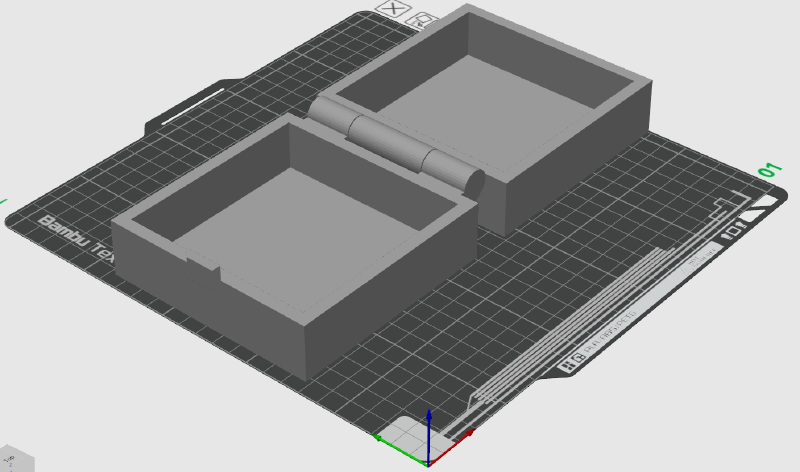
This is clearly not large enough for my 7.3 x 5.8 inch requirement. Even if I removed the margins entirely, the 5.3 inch length of the SAMV71 Xplained will not fit in a design like this. Although I could print two separate pieces and put them together, this will take a lot of print and assembly time. The first pass model is also not cost effective with ~130g of filament that costs $1.82 at today’s prices.
Off-the-shelf Static Safe Storage #
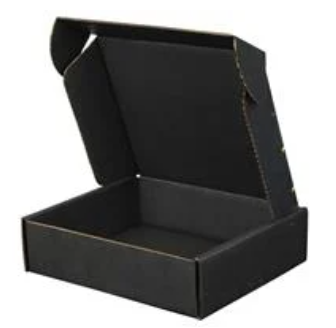
Since it doesn’t look like homemade boxes will work, I turned to complete off-the-shelf storage solutions with both mechanical and static protection provided. There are a massive number of these solutions on the market and in order to pick one the type of foam needs to be decided. Like most engineers I am familiar with seeing the pink anti-static foam in many use cases, but unfortunately that foam gets its anti-static properties from a “surfactant” that degrades as moisture is absorbed. Based on information online, the pink foam solutions have a lifespan of 6 - 12 months. Luckily there are other materials like black static foam or ESD safe plastic that have longer shelf lifes.
Starting at DigiKey there are nearly 300 in-stock SKUs with the longer lasting materials. Filtering out items with no “Storage” use defined there are 225. Further filtering out obsolete items, items with a dimension less than 5.5 inches, and open top bins I arrive at the cheapest option as the Protektive Pak 37054 which currently costs $3.8426 at quantity 50. This is a much quicker solution to implement than the 3D printed box, but it comes with a price doubling.
Off-the-shelf Modular Solution #
Given that cardboard boxes are cheap, and ESD bags are cheap, there must be a way to assemble mechanical and static protection pieces to come up with a solution that is both cost effective and fast. For the boxes, I turned to Amazon to find 7x5x2 inch cardboard boxes that cost $0.56 each. Turning back to DigiKey for bags, there are 5x8 inch bags that cost $0.15 each. With these two items we have the start of a solution that costs less than $1 per item stored.
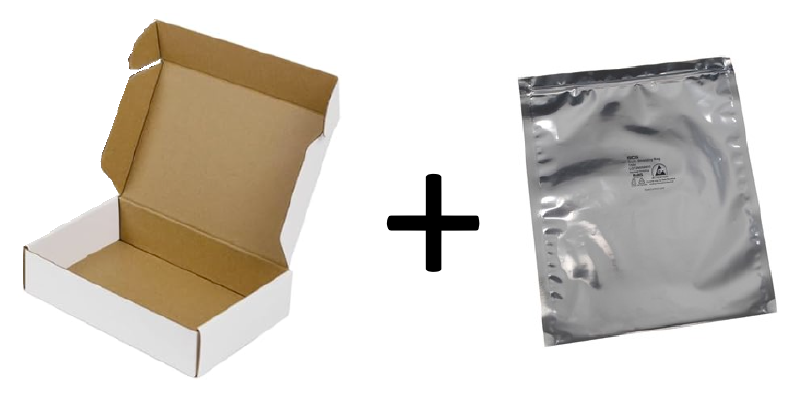
Since this solution is less than half the cost of the first two, it is worth quickly revisiting our initial requirements to make sure we’re still on the right track:
- Mechanically protect - YES
- Electrically protect - YES
- Labelling surface - YES (2 inch box edge)
- Affordability (<$5) - YES (not even $1)
- Physically constrained - Somewhat. The oversize ESD bags offer some protection but parts can still slide a little.
- Minimal physical overhead - YES, 5x7x2 is a nice compromise to fit my largest PCBA and not be too large.
- One size fits most - YES (5x7x2 fits all 8 sample parts)
- Last indefinitely - To be determined
According to one supplier of ESD bags, SCS, their bags are warrantied for 1 year, but can last in controlled environments for 5 years. In some extreme situations, they even report some lasting for 20 years! Since in this setup the bags are shielded from UV by their placement in cardboard boxes, and I’m storing them in a basement with relatively constant temperature, I am optimistic that ESD bags will last a very long time.
Labels & Software #
To keep track of my inventory, I am using HomeBox. This allows me to create a database of parts that I can digitally search through. In addition to the enhanced searchability (relative to searching through totes) I can assign locations to items to know exactly what area of my basement contains the item.
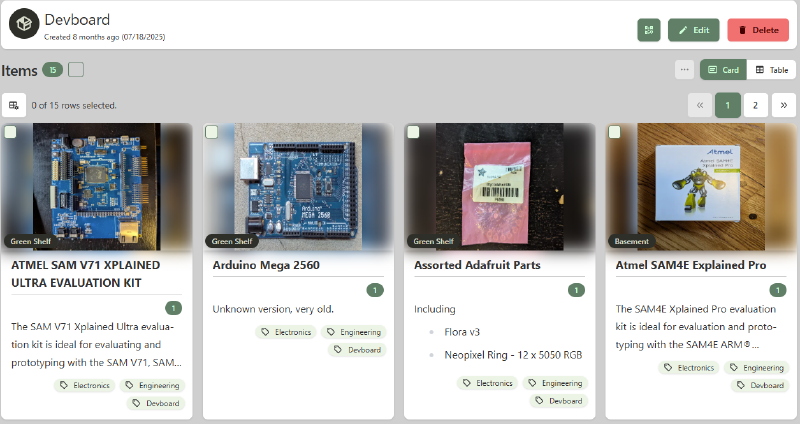
HomeBox also has a label generator tool that allows sheets of Avery 5260 labels (1.3 cents per individual label currently) to be printed so boxes can be labelled, scanned, and the item documentation brought up.
Conclusion #
All summed up, ESD bags, cardboard boxes, and address labels give me a storage system that costs $0.723 per item. This drastically overperforms the other two systems that I had considered.
I’ve been using this system for a few months now and I really like it. I can look at what specific versions of boards I have, when I bought them, what I paid for them, and where I left them (as long as I keep the discipline to put them back).